writing · Writing Goals

A Writer’s Plans in 2020

So far the start of the year has been incredibly busy! That’s a good thing, since I’m gearing up for a big year in 2020. The blog has been pretty quiet lately, and it will likely continue to be so until summer. Why? Because for the first half of 2020 I will continue to be a writer with a day job. This means that like 2019, I won’t get as much done as I dream of, but I still have plans. And what happens in the second half of 2020? Well, my savings goal will have been reached and I will once again be transitioning to full-time writing. I am so excited for this that the impatience is quickly growing.

81753F43-8E62-4CBA-A28F-3858A767E7ED

On the docket for 2020 are a number of things, first and foremost to continue working on my current work in progress, By Sapphire Light. This is a young adult steampunk fantasy that I just love working on! I finished the first draft in December, and have recently begun the first rewrite, which is moving along nicely! In early January, I also worked on a few other small projects that I plan to continue with for the rest of 2020.

My main goal this year is to get the entire trilogy for By Sapphire Light drafted. This means two more books to draft, and the first one to finalize. I would love to have this done by July 1st, before I transition to full-time writing, since I have many other projects that will be vying for my attention at that time.

IMG_4059

The good thing is I have a writing retreat booked in late February, which will carve out sometime in the first half of the year for writing. I’m continuing with my Wednesday writing night, and have been pretty good at chipping away on my project on evenings and weekends. I’m hopefully that I can get one more mini-retreat in before June as well.

When I did my writing goal planning for 2020, I actually only planned for the first six months, since I’m not exactly sure how things are going to line-up for July. I’m trying to let things flow, and see what comes more naturally now while I’m balancing work life-home life-and writing life. Here’s to a great year in 2020 for everyone!

JEH

writing · Writing Goals

How to Be a Writer with a Day Job: A year’s roundup.

At the start of the year I was planning to write a post a month about how to be a writer with a day job, in other words, how to find time for writing when you’re working 40 (or more!) hours a week! I managed to get out two posts! Which may tell you a lot about where my priorities lay when I’m a writer with a day job.

IMG_5603

It was much easier to fit in blogging when I was a full-time writer. But being a full-time writer isn’t always the most economical decision (though it is the most heart-lightening one). I switched my day job in June of 2019, and that day job currently takes up a lot more of my time than my old job did, but all for a greater purpose. I changed jobs (well aware that I would lose writing time) to make more money, to save more, to then get back to being a full-time writer sooner (once my cushion is adequately plumped).

IMG_0391

And taking that job has also taught me a lot more about being a writer with a day job. Here are some tips I picked up over the past six months:

  1. Make social media your last priority. Yes, that’s right. If you want to get writing done, or even worse, the dreaded rewriting, don’t go on social media. This may result in your on-line presence lagging, but hey, I didn’t get into writing fiction so I could write for social media 24/7. That said, I’m still trying to make time for some blogging, but I do this by trying time to pre-post once a week—or month! But even that doesn’t always happen.
  2. Keep your goals tight. When you have a day job, you don’t have as much time, which means you can’t pursue as many projects. While I love to have multiple things on the go: short stories, novels, novellas, fantasy, general fiction, I can’t work on them all when I’m already spending 40 hours a week at my day job desk. So pick one and work on it until it’s finished. Then pick something else.
  3. Find a community. I still get the majority of my writing done at my Wednesday night meet-ups. My like-minded community of writers knows we have to set aside time to get work done, so that’s what we do. But beyond writing together, we also have regular goals meetings to hold each other accountable to the goals we set at the beginning of the year.
  4. When you burn out, take a break. Having a day job might mean that you burn out sooner, more often, and harder. Make sure to give yourself a break, a night off, a night out, a morning to sleep in. You can always pick up the pen tomorrow. Just make sure you do.
  5. Drink a lot of coffee. I’m pretty sure that one explains itself.

Hopefully at least one of those tips resonates with you. It’s been a long haul this year being a writer with a day job, but I made it, and next year is going to be even better yet!

JEH

nanowrimo · writing · Writing Goals

How I Won NaNoWriMo, and How I’m Winning My Writing Year

I did it! I won NaNoWriMo again! And this was probably the easiest year for me because I love my current Work in Progress so much! I’m very happy that I managed to push through NaNo this year, especially given that I’m in the middle of a major house renovation (Hello New Office! —More on that later).

First I want to talk a bit about how I managed to win NaNo when I’m so busy, when I have an incredibly busy day job, a busy personal life, and a major renovation going on right now.

I did it by making time. Every night I did some writing. If I didn’t make the full 1676 words per day one day, I tried to make sure I could catch up the next. I booked time for myself on the weekends to get extra words done, I made it to my weekly writing productivity meet-ups, and we had one Saturday marathon where I wrote a whopping 11,000 words to pass the 50,000 word mark. (I may have bought myself a box of chocolates to cheer myself on… They may also now be all gone…). You can see my daily wordcount summarized below, along with my wordcount since July 1, 2019, when I decided I would write 500 words a day for an entire year!

Screen Shot 2019-11-28 at 9.27.41 PM

So, I won NaNo, and I did it by making time, but also by focusing on my task. When I sat down to write, I wrote. I didn’t daydream or browse the internet or get lost in research like I often do, I just got to it because I knew that my time was limited. This is why I love NaNo, because it gives me a deadline, and deadlines can be the best motivation of all.

Did you do NaNoWriMo this year? What gave you motivation to work?

JEH

writing · Writing Goals

How to Be a Writer with a Day Job: Part 3 – Making Progress

The one thing I have been struggling with most lately, as a writer with a rather demanding day job, is progress. What do I mean by progress? To me, progress means writing a page of new words, rewriting a book scene by scene, or sending something out on submission. It means moving further along on the path toward finishing something. But lately, I’ve been standing in a deep puddle of stagnated water, the finish line far, far away.

I’ve been here before, I know how to get out of it. But when I come home from work exhausted and tired of computers (already having stared at one for 8 hours), sometimes I just want to curl up and binge watch Grey’s Anatomy (after not watching for a couple years, I’m three seasons behind and have a lot of episodes left to go! Tempting!)

As a writer with a day job, exhaustion can be your worst enemy. There are many ways to try to combat this, ways you can trick yourself into sitting down in your desk chair with your writing computer and start. Not all of the following suggestions will work for everyone—they certainly don’t all work for me. But if you try them all, hopefully, you’ll find one that works. Because one of the most important things about being a writer with a day job is consistency. Here are some small things you can do to continue making progress on your Work-In-Progress.

IMG_5603

  1. Wake up Really Early – I’m going t be honest, I do not do this. I am not a morning person and this would not work for me. But I know a lot of writers who do follow this practice and it works for them. This is about setting aside to write before heading to your day job and spending your best time writing before you feel wiped out. If you’re a morning person, this might be for you.
  2. Write Really Late at Night – This is my chosen method. I find that when I first come home from work, I’m exhausted. I need a break, so I give myself one. I open up my computer after I’ve had three or four hours to compress from the day job, maybe done some exercise and had supper. Then I take about a half an hour to get some work done. The key thing here is to not do this immediately before going to bed since staring at a computer screen might mess with your circadian rhythm. Instead, work up until 30 minutes before you want to go to sleep, and then switch to reading or some other calming activity. IMG_5388
  3. Write on a couple specified days a week (most likely the weekend) – Almost everyone out there says to be a writer you have to ‘write every day’. If you have a day job, this is likely not your reality and I don’t believe it has to be. Writing can mean more than sitting down and getting out words every day, it can just be thinking over your plot lines or character development or doodling in a notebook. But it is important not to let too many days go by or you might forget where you were at (on this note, make sure to leave yourself a good note about what you need to do next). Lately, I’ve been squeezing in writing time on Wednesday nights and on Saturday or Sunday, and I find this is often enough that I don’t forget what I’m writing about.
  4. Find a Writing Group – As mentioned about, I have a writing group. We meet weekly just to sit in a quiet space and write. This group is all about productivity which is what I need right now. A writing group that spends hours talking and providing feedback might not fill the same purpose, so consider what your needs are when looking for a writing group of your own.
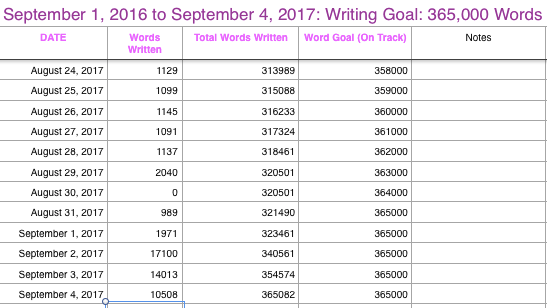
  5. Set Goals and Track Them – This can be important, especially for those that are motivated by seeing numbers on paper. The other year, when I wrote 365,000 words in a year (only 1,000 words a day), my productivity shot sky high. I tracked my daily writing goal in an Excel spreadsheet, and seeing the running total was a big motivator for sitting down and getting stuff done. (I’m no longer doing this and my productivity has dropped, surprise surprise).

Screen Shot 2017-09-04 at 10.41.58 PM

No matter where you are in your writing journey, it is important to a writer’s happiness to see progress being made. Keep in mind that this doesn’t have to be large progress – you don’t have to write a book in a week, or even a book in a month, but you do need to move forward if you want to reach the finish line!

JEH


writing · Writing Goals

How to be a Writer With a Day Job Part 2: Don’t Let Those New Ideas Run Away With You

One of the most difficult parts of being a writer with a day job that I didn’t realize until I was no longer a full-time writer, is how difficult it is to keep your head on your current Work-In-Progress. (Aside: This month marks one year since I started my grant time, that wonderful four months where I got to be a full-time writer with no worries). When I was writing full-time, the majority of my day consisted of thinking of my characters, of writing about my characters, opening up one story and closing it off. Now my days consist of scrambling to get little ones to day care, struggling through morning rush-hour traffic, checking office emails, making clients happy—and above all, spending most of my brain power on my day job. My escapes tend to be daydreams that mostly involve new, great ideas. Because—for whatever great-cosmically-inspired reason—new ideas require less brain power than old ideas.

IMG-2340

New ideas “just come to me”, they “fall in my lap”, “appear out of nowhere”, “must be really good if I can already see it”, and all of these little reasons I tell myself lead to the New Idea Trap.

The New Idea Trap is the reasoning that the new idea, the one you haven’t spent any time on, is the good idea. It is the one that someone will love enough to publish and give you a large advance for. The reality is that it is only good because you haven’t done any actual work on it yet. Just like the new job you got at Burgers R Us feels like it will be an amazing career where you make lots of money until you actually have to wake up at 6 in the morning to get to work on time. Work feels easy until you are actually working. Ideas are just ideas, they aren’t a book, story, or completed series yet.

So, how do you put aside those new ideas and focus on your current work in progress?


IMG-2314
Possibly by drinking coffee and writing really fast? Maybe…


What I do is track my new ideas. I give myself a bit of time with them. I write a few pages of background, maybe a character sketch or two, I might draw a map or write the first scene. Then, often, the fire dies down. I begin to see how much work the New Idea is actually going to be. How much of my time the New Idea is going to eat up. And I see that I’ve already put so much time into my WIP that it is better to stay that road, and move onto the New Idea once I’ve finished my WIP, once I’ve felt that sweet, sugary bite of accomplishing my goal.

But I don’t lose track of my ideas. I keep them all tidied up a few journals, tabbed with sticky notes. I keep lists of these works. And one of my favorite parts of writing is when I finish one projects, and get to pick the next one from the list. I spend time reviewing each of my potential creations, and see which one captures my attention at that moment.

And then I get to work, again. Idea book by my side, to capture whatever stray ideas cross my path while I’m sitting at my (day job) desk.

JEH

Blogging · writing · Writing Goals · Writing Prompts

How to Be a Writer With a Day Job Part 1: Making Time

At the beginning of January I announced that I would be doing a series this year on being a Writer with a Day job. I planned my first post for January 2019, but here it is, February 1, blizzardy and cold, and I’m just getting round to it now. Ah, the realities of being a writer with a day job.

Last year, I had the amazing privileged of being awarded a literary grant, which gave me a full four months to work as a writer with no other distractions. Then, when July came, I returned to my demanding day job and this gave me an entirely new perspective on what it is be creative and to work at a regular 9-5 where you have a boss, and assignments, and things to do that must get done, none of which have anything to do with crafting fantastical universes. When I returned to my job, I was struck with one particular wallowing grief: how will I make time for my art now???

IMG_5603

If you’re like me, wanting to create day after day, wanting to figure out how you will ever find time to finish your novel, your short story, your poems—or heck, even start those projects in the first place—then I’m glad you’re here. Because today that’s what I’m going to talk about, albeit rather briefly, because I have a day job to return to (Ssssh, don’t tell my boss).

#1 Search

The first thing you need to do, if you are a writer or artist working a day job, is take a long-distance look at the time you have every day for everything: regular work, home life, friends, television, the gym, sulking. Lay it all out and then move in really close and find those places you can block off just for writing. It might be that every Saturday morning you nothing for the first three hours. Why not book off one or three for writing. What about your lunch breaks? Are you really using them productively? Maybe instead of using the time to browse Facebook posts that you’ve likely already seen five times before, use ten minutes to squeeze out one hundred word on your work in progress. Take a look at your time and figure out where writing can naturally fit in. It might not be a lot of time, but a little bit adds up over a year or two.

#2 Cut

The next thing you can do is cut. Cut ruthlessly. Cut out mind-trash, and instead create a little of mind-building. In other words, stop watching so much television. Stop binging on NETFLIX. Stop watching stuff you aren’t paying attention to anyway because the characters are all immature and whiny and terrible. When people ask me how I fit in time for writing, my first answer is “I don’t watch television anymore”. You know what everyone tells me, “Oh, neither do I. Except for Black Mirror, Riverdale, Sabrina the Teenage Witch, and Grey’s Anatomy. I mean, I down to like only six or seven shows.” That’s six or seven hours a week you could be writing! In fact, if you even just picked your two favorite shows, that four hours a week you could be writing. Four hours that you could be working on the world you really want to be in instead of numbing your mind with someone else’s creation. Honestly, I maybe watch half and hour to two hours in a regular week. And yes, I do binge on occasion, or watch a new release movie I’m really interested in, but I’m ruthless with my time, I want it all for my writing. All of it. But I know I should find balance, too.

#3 Marathons

A few years back I found this amazing writing group. It’s amazing because it’s a writing productivity group. We get together regularly on Wednesday and writing straight for three hours (it’s come and go so you can really just be there for as long as you choose). We don’t talk much. We just write. I get a lot of creative work done on Wednesday nights. But another thing we do a few times a year is marathons. We find a Saturday or Sunday and book off a day, a whole day, for sitting together in silence and writing. It may sound strange, but there is something about being surrounded by other writer’s writing that keeps you honest. You can’t slack off and watch Netflix, you can’t start cleaning your house, you can’t lie on the floor and wallow in writer’s block. People are watching (well, not really, but they are noticing), so you have to work. You have to spend the whole day working. And it’s amazing where one long day dedicated to a single project can get you.

JEH